Latest Posts
News, insights, and updates from RootPath.
-
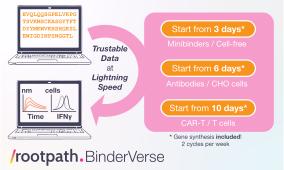
Sequence to function in 3+ days, with data you can trust
The design-build-test-learn (DBTL) iterations in protein design demand rapid generation of high-quality yet affordable wet-lab data. Conventional CROs tend to lack agility, while many new, automation/AI-first cloud labs lack the experience or rigor in biologics drug development. RootPath’s BinderVerse offers you the best of both worlds.
Read more → -
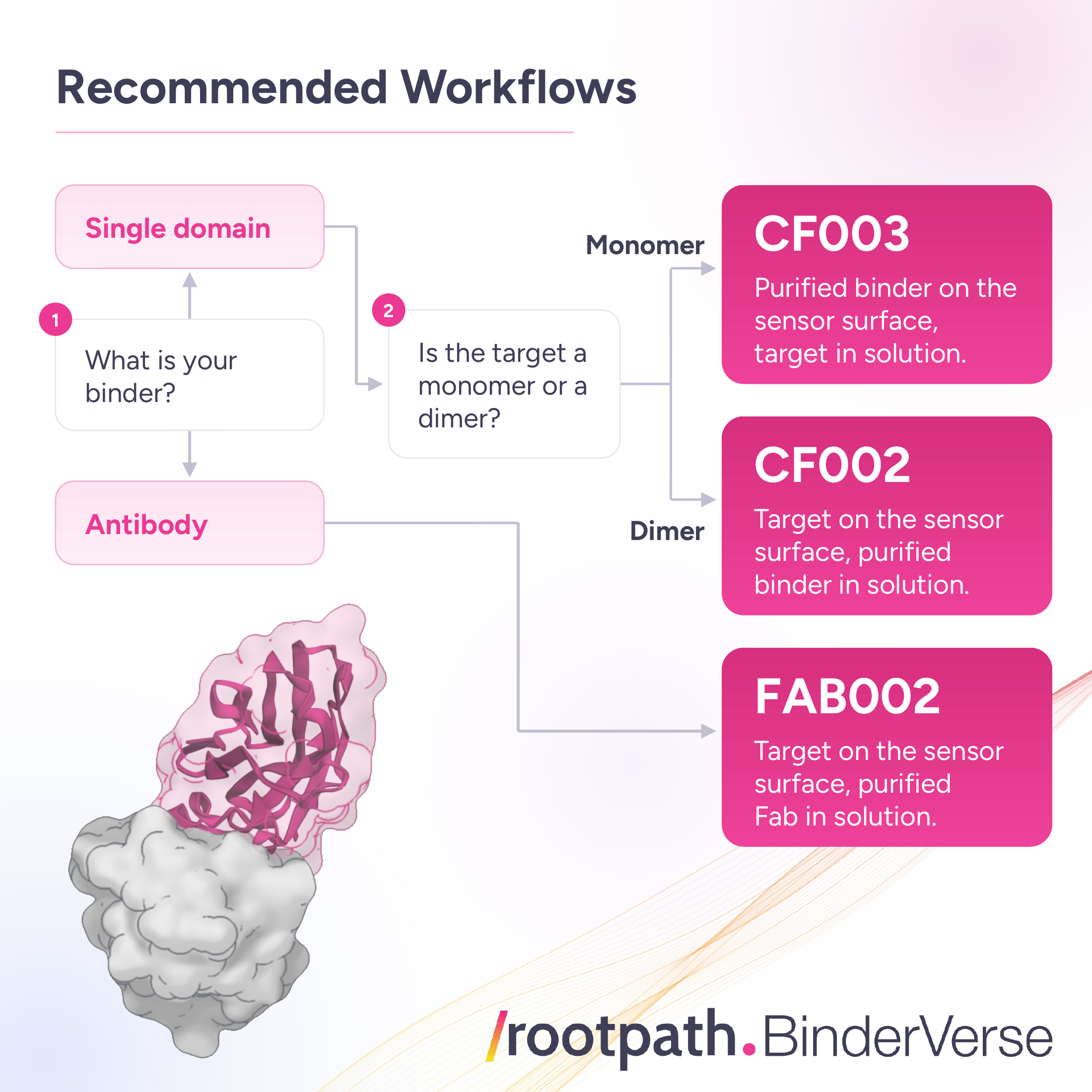
Which workflow should I use?
Two questions settle it. Is your binder a single domain or an antibody, and is your target a monomer or a dimer? Here’s the decision tree and the reasoning behind each branch.
Read more → -
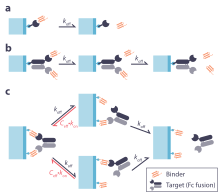
Are your $k_{\text{off}}$ and $K_{\text{D}}$ measurements fooled by valency?
How to avoid rookie mistakes when selecting BLI/SPR format
Read more → -
Balancing speed and data quality in rapid antibody affinity testing
Mammalian cell-based expression systems using CHO or 293T cells have been the gold standard for expression of antibodies and antibody fragments for decades, for good reasons. We argue that they remain the top choices for rapid testing of binders in the age of AI-powered protein design. To empower your antibody design work, in the BinderVerse platform we can achieve a turnaround time (from AA sequence to binding curves, gene synthesis time included) as short as 6 days.
Read more → -
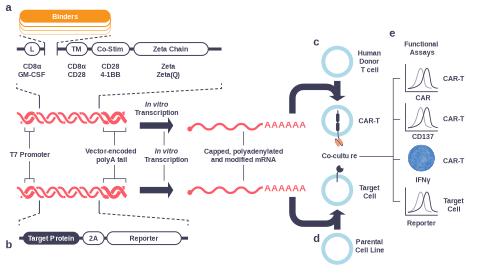
CAR-T R&D Superhighway: From sequences to T cell functions in 10 days
CAR-T structure is remarkably modular, yet CAR-T research requires experiences in many blended areas. We leverage our deep experience in T cell biology to digitize CAR-T R&D for protein designers.
Read more → -
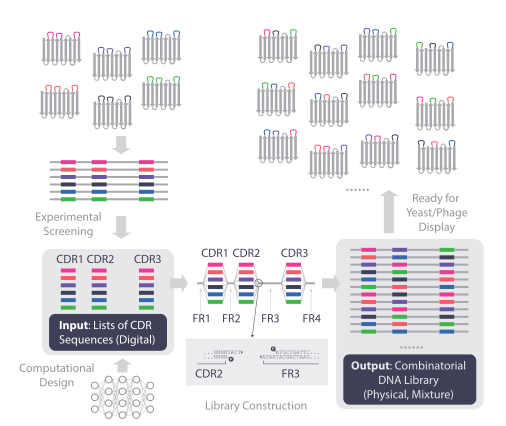
Combinatorial CDR Shuffling: Maximize Your VHH Search Space
Computational design and initial screening of VHH libraries often yield hundreds of candidates, each carrying distinct CDR1, CDR2 and CDR3 sequences on a shared framework. Recombining these CDRs could unlock ultra-performing binders – but building the combinatorial pool with defined junctions has always been non-trivial. Here’s how RootPath’s VHH CDR Shuffler™ turns three lists of CDR sequences into a uniform, high-fidelity combinatorial DNA pool in as few as 5 days.
Read more → -
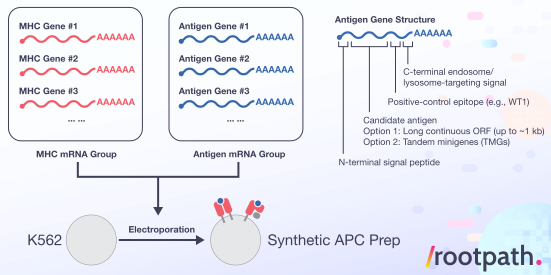
How do we ensure all MHCs of interest are expressed?
In cell-based assays of TCR:pMHC recognition, such as our TCR Decoder™ service, it is critical that all functional candidate MHC molecules are expressed. This is easier said than done. Here’s how we ensure this through an elaborate scheme, how biology and common reagents throw curve balls at us, and how we overcome the challenges.
Read more → -
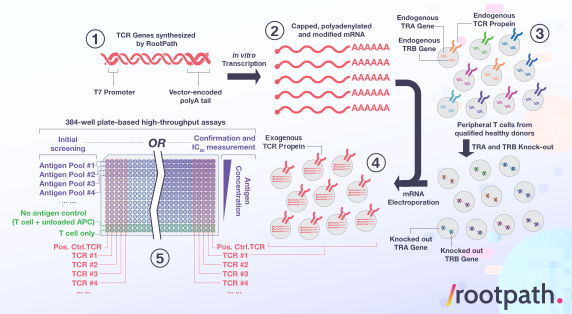
Bringing TCR:pMHC Validation to the Digital Age
With the advances of single-cell sequencing technologies and AI-based protein design, discovery of candidate TCR (and TCR-mimicking binder) sequences has never been faster. However, experimental methods for TCR:pMHC validation appear to be stuck in the 20th century. Existing tools such as soluble pMHC multimers, B-lymphoblastoid cell lines (B-LCLs) and monocyte-derived dendritic cells (MDDCs) are often unavailable, while preparation of TCR-T cells is also slow and low-throughput. In this post, I discuss how services like RootPath’s TCR Decoder™ addresses all of these issues, and allow you to turn digital information such as TCR sequences, patient HLA types and candidate antigen sequences, into cell-based functional readout in as short as 3 to 4 weeks, dozens to hundreds of TCR sequences at a time.
Read more →